Building the Foundation: Game Editor & Server
Before there is a world, there must be tools to build it. Over the past months, a significant part of our effort has gone not into the game itself, but into the infrastructure that will let us create it — and eventually let you play it without ever installing anything.
The Game Editor
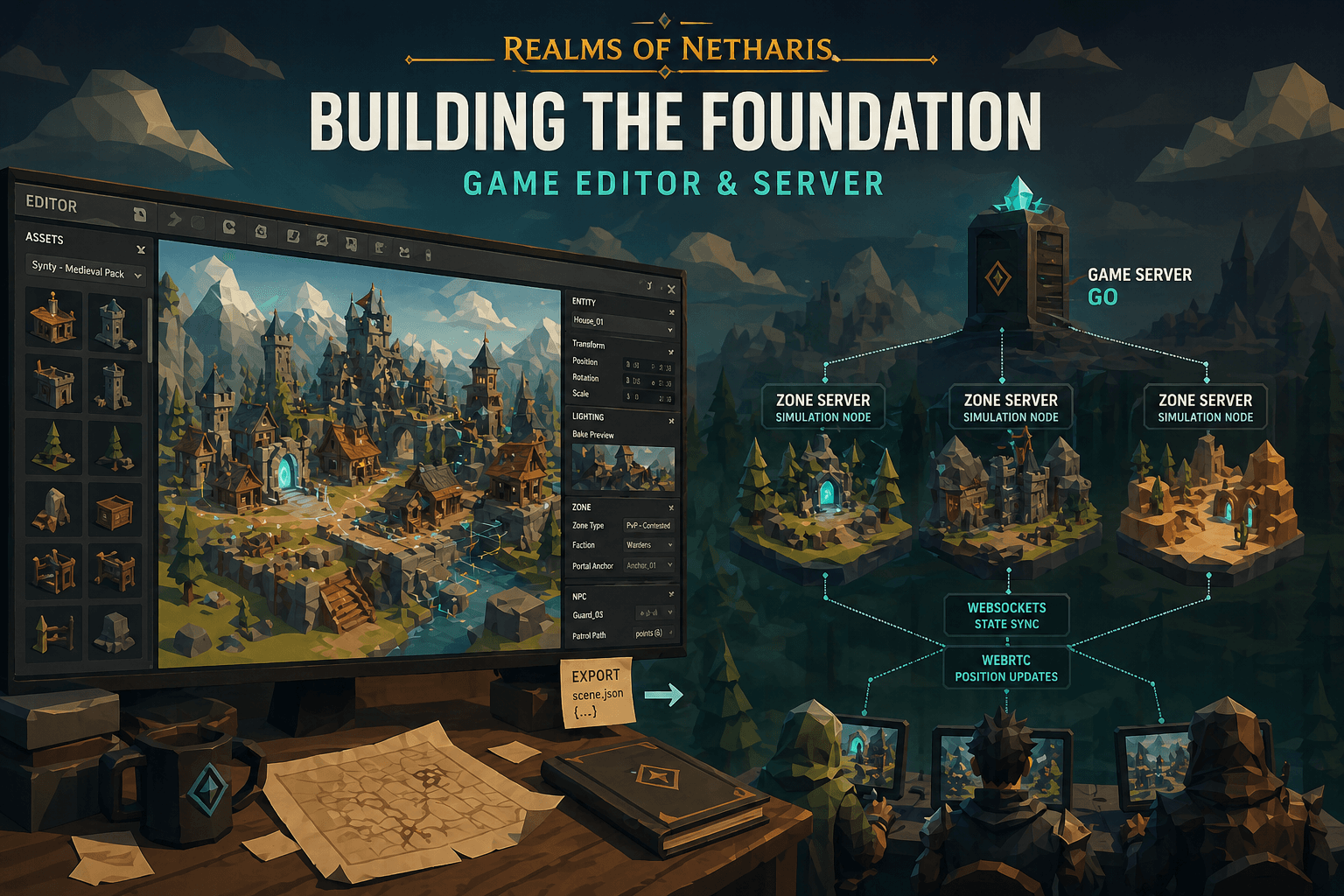
We are building a custom scene editor that runs entirely in the browser using WebGPU. This is not a decision we took lightly — most teams reach for Unity or Unreal. But since Realms of Netharis is a browser-first game, having an editor that runs in the same environment as the game has a concrete payoff: what you see in the editor is exactly what players see, with zero translation layer.
The editor currently handles asset placement, terrain sculpting, light baking previews, and portal zone definition. We can load Synty asset packs, position and scale meshes, and export scene descriptors that the client runtime reads directly. It is rough around the edges — but it works, and we use it every day.
- ◈WebGPU-based viewport with real-time scene preview
- ◈Asset browser with Synty pack integration
- ◈Zone tagging (PvP type, faction territory, portal anchors)
- ◈NPC placement and patrol path editor
- ◈Export to JSON scene descriptors consumed by the game client
The Game Server
The server is a Go-based architecture designed around two concerns: authoritative simulation and horizontal scale. The world is divided into zones, each managed by a dedicated simulation node. Clients communicate over WebSockets for real-time state, with a secondary WebRTC data channel for latency-sensitive player position updates.
The Memory system — the game's third vital gauge — is stored server-side and treated as authoritative. This is intentional: Memory has faction and narrative consequences that cannot be left to client-side calculation. It is synchronized on meaningful events, not every tick.
“The goal is a server that disappears from the player's awareness entirely. You open a tab, you are in the Sanctuary. The infrastructure is invisible.”
What's Next
The next milestone is a first playable zone — a ruined Sanctuary district with basic movement, NPC interaction, and one Harvester encounter. Not a demo. Not a trailer. A real slice of the game, running in your browser.